Summary: Golf carts are a popular and practical mobility option for seniors in 55+ communities and retirement neighborhoods throughout California. The features that matter most for older drivers are a low step-in height for easy boarding, smooth and predictable acceleration and braking, comfortable seating, and seat belts for all passengers. Standard electric 2 or 4-passenger carts are the best fit for most retirement community use. Lifted carts are not recommended for seniors due to higher step-in height. Lithium battery models require the least maintenance. On private community property, a driver’s license is generally not required in California. On public roads, an LSV-registered cart requires a valid license. New carts suitable for senior use start around $7,000 to $13,000. Quality used options are available from $5,000.
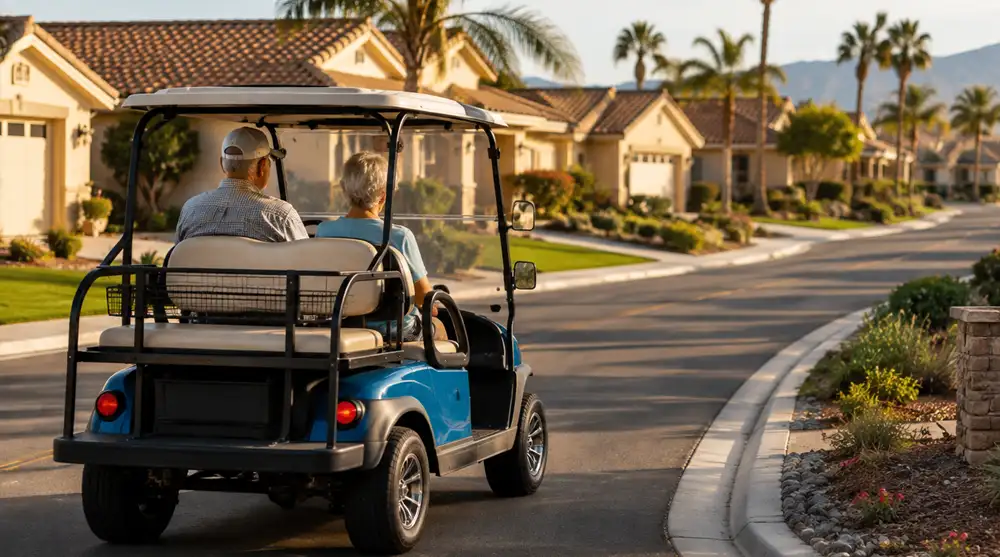
Golf carts have become a fixture in retirement communities across California. In planned 55+ neighborhoods in Visalia, Fresno, Tulare, and throughout the Central Valley, you will see them parked in driveways and moving along community paths on any given afternoon.
For many seniors, a golf cart is more than a recreational vehicle. It is a practical tool for independence. It allows someone who finds long walks difficult to visit neighbors, run errands within the community, get to the clubhouse, and stay engaged with daily life without relying on family or a full-size vehicle for every trip.
This guide is written for seniors considering a cart for their own use, and for adult children helping a parent navigate the decision. We cover the features that actually matter for older drivers, what California rules apply, and how to evaluate a cart honestly for senior-specific needs.
Why Golf Carts Work Well for Senior Mobility
A golf cart operates at low speeds in a familiar environment. Most retirement community roads are straight, well-maintained, and lightly trafficked. That is an ideal setting for a vehicle that tops out at 15 to 25 miles per hour.
The low speed is actually a feature, not a limitation. It reduces the consequences of minor errors in judgment. This gives the driver more time to react. It creates a more forgiving environment for someone who has not operated a vehicle in a few years or who is adjusting to changes in reaction time or vision.
Electric carts have smooth, gradual acceleration rather than the sudden torque of a gas engine. That consistency is easier to manage for drivers who find abrupt acceleration unsettling. Braking on most electric carts is also predictable and progressive, without the sudden grabbing that older drum brake systems on gas carts sometimes produce.
The social dimension matters too. A golf cart in a retirement community is a connector. Neighbors stop to talk. Trips to the pool or clubhouse become more spontaneous. People who might otherwise stay home because a walk is too far get out more often. That social engagement has real, documented benefits for cognitive and physical health in older adults.
Features That Matter Most for Senior Drivers
Not all golf carts are equally well-suited for senior use. Some features are important for any cart. Others matter specifically when the driver is older or when mobility is a consideration.
Step-in height is the first thing to evaluate. A cart that requires a large step up to enter and exit creates a daily challenge for someone with limited knee flexibility, hip mobility, or balance concerns. Standard non-lifted carts have a low floor entry that most seniors manage comfortably. Lifted carts add 4 to 6 inches of height to that entry point, which is meaningful for someone with joint issues. If a parent or spouse has difficulty with standard car entry, test the cart entry specifically before purchasing.
Seat comfort for longer rides is the next factor. Retirement community use often means multiple short trips per day rather than one long one, but cumulative seat time adds up. A cart with adequate cushioning and a supportive seat back reduces fatigue and discomfort. Many carts can be fitted with upgraded seat cushions if the factory seat is not comfortable enough.
The accelerator pedal feel matters more than most buyers expect. Some carts have a hair-trigger pedal that surges forward with light pressure. Others have a smoother, more proportional response. For senior drivers who may apply pressure inconsistently, a cart with a smooth and gradual accelerator is noticeably easier and more confidence-inspiring to operate.
Braking should feel firm, responsive, and predictable. Test the brakes during any test drive. Press them at low speed and feel how the cart responds. A cart that requires significant foot pressure to stop, or one that brakes unevenly, is not the right choice for a senior driver.
Visibility from the driver’s seat is worth checking. The steering wheel should sit at a comfortable height without requiring awkward arm positioning. Mirrors, if present, should be adjustable to a position that gives a clear view without straining the neck. Good forward and peripheral sightlines from the driver’s position matter on any road, even a quiet community path.
Seat belts are non-negotiable. Any cart purchased for senior use should have seat belts for every seating position. Even at low speeds, a sudden stop or minor collision can cause injury to an older rider who is not belted in. This is especially important if the cart is ever used on a street-legal or mixed-use path.
Electric vs. Gas for Senior Use
For retirement community use, electric is the clear choice. The reasons are practical rather than philosophical.
Electric carts require minimal maintenance. There is no oil to change, no fuel to purchase, no engine to tune. Charging overnight on a standard household outlet is the only routine task. For a senior who does not want to manage a mechanical maintenance schedule, that simplicity is a significant quality-of-life advantage.
Electric carts are quieter. A gas cart idling and accelerating nearby is noticeably louder than an electric one. In a retirement community where residents spend time on patios, in gardens, and near their neighbors, that noise difference is real and appreciated.
Electric carts produce no fumes. That is relevant for anyone spending time around the vehicle regularly, particularly in a garage or carport where ventilation may be limited.
Lithium battery models are the best choice within the electric category. They require no watering, charge faster, and maintain consistent performance across the battery’s discharge cycle. A lithium cart at 50 percent charge performs the same as one at 100 percent. That consistency is valuable for a driver who may not always remember to fully charge before a trip.
California Rules for Retirement Community Golf Cart Use
Understanding the rules before purchase prevents surprises later. The rules in California depend on where the cart will be driven.
On private property within a gated community, a golf cart does not need to be registered or insured, and California does not require a driver’s license to operate it. The community’s own rules may add requirements, so checking with the HOA is always a good step.
If the cart will ever travel on public roads, even briefly to cross a street between two parts of a community, it needs to meet California’s LSV requirements. That means a VIN, registration, insurance, headlights, taillights, turn signals, mirrors, seat belts, and a windshield. The driver also needs a valid California driver’s license.
Our guide on golf cart license plates in California covers registration in detail. If there is any chance the cart will be used on public roads, getting a street-legal configuration from the start is cleaner than retrofitting later.
For street-legal carts, insurance is required. Our California golf cart insurance guide explains what coverage costs and what is required for LSV operation.
What to Budget for a Senior Golf Cart
A new 2-passenger electric golf cart suited for retirement community use starts around $7,000 to $10,000. A 4-passenger model with better comfort features and a more complete accessory package runs $9,000 to $13,000.
Used carts are a strong option for seniors who want reliability without paying new cart prices. Our inspected used golf carts for sale start around $5,000 and offer solid performance for community use. Every used cart we sell has been through our service department before it goes back on the lot.
Financing is available on both new and used inventory. Monthly payments on a $9,000 cart financed over 48 months typically fall in the $200 to $250 range depending on rate and down payment. Our golf cart financing guide explains the options in full.
Advice for Adult Children Helping a Parent Choose
If you are helping a parent or older family member select a cart, a few pieces of advice make the process smoother.
Involve them in the decision. A senior who picks their own cart is more invested in using it correctly and maintaining it. A cart chosen entirely by an adult child sometimes sits unused because it does not feel like theirs.
Focus on the test drive. Reading specs online does not tell you whether the accelerator feels manageable, whether the seat is comfortable to enter, or whether the brakes feel responsive to your parent’s foot pressure. These things only emerge in person. Come to the showroom and let the person who will be driving do the evaluation.
Do not default to the cheapest option. A cart that is difficult to enter, uncomfortable on longer rides, or has inconsistent braking creates safety concerns that outweigh any cost savings. The right cart for a senior is one that inspires confidence, not anxiety.
Consider what the community allows. Some 55+ communities have specific rules about cart colors, accessories, or maximum speed settings. Check those before customizing or modifying the cart after purchase.
Our team at Central Valley Carts in Visalia works with senior buyers and their families regularly. We know how to match the right cart to the right person without overselling features that do not matter or underselling safety features that do. Come in or reach out and we will make the process straightforward.
Frequently Asked Questions
Are golf carts safe for seniors to drive?
Golf carts can be a safe mobility option for seniors when the right cart is selected and used within appropriate settings. Key safety features include a low step-in height, easy entry and exit, a responsive brake system, seat belts, and good visibility. Seniors with limited grip strength or mobility challenges should test drive before purchasing.
What features should a golf cart have for senior drivers?
The most important features are a low step-in height for easy boarding, a supportive and cushioned seat, a smooth and responsive accelerator, an effective braking system, seat belts for all passengers, and good lighting. A steering wheel at a natural comfortable height reduces fatigue on longer rides.
Do you need a driver’s license to drive a golf cart in a 55+ community in California?
On private property within a gated community, California does not require a driver’s license to operate a golf cart. If the cart is a street-legal LSV for use on public roads, a valid California driver’s license is required. Community HOA rules may also set their own requirements.
What is the best golf cart for a 55+ retirement community?
The best cart for retirement community use is a standard 2 or 4-passenger electric model with a low step-in height, comfortable seating, smooth acceleration, and good braking. Lithium battery models are preferred for consistent performance and minimal maintenance. Lifted carts are generally not recommended for senior buyers due to higher step-in height.
Can a golf cart be used as a mobility aid in a retirement community?
Yes. Golf carts are widely used as personal mobility aids in retirement communities for seniors who have difficulty walking longer distances but can safely operate a low-speed vehicle. They support independence for shopping trips, visiting neighbors, and accessing community amenities.
How much does a golf cart cost for a senior in a retirement community?
A new 2-passenger electric cart suitable for retirement community use starts around $7,000 to $10,000. A 4-passenger model with comfort features runs $9,000 to $13,000. Quality used carts are available from $5,000 and can be a strong value option. Financing is available to spread the cost over time.