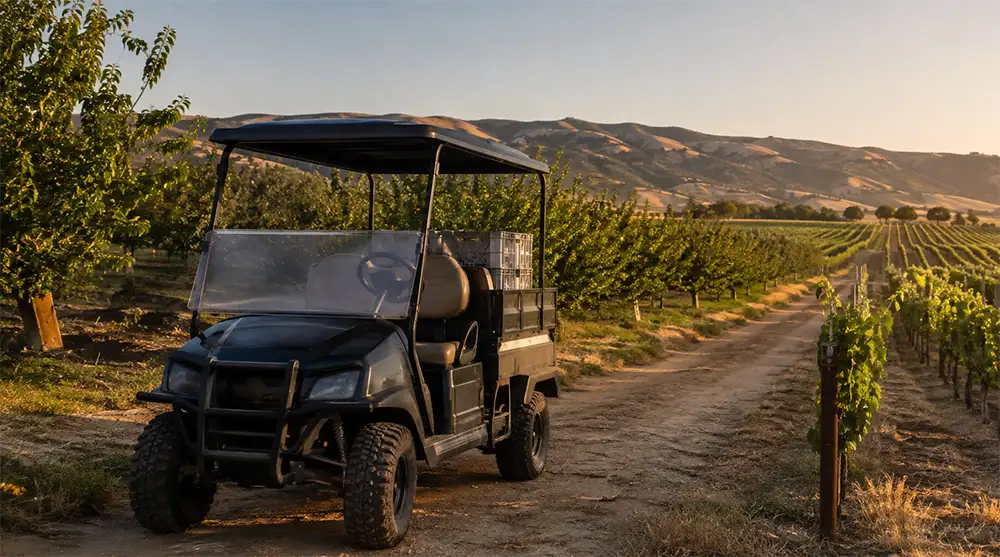
Summary: Golf carts and electric utility vehicles are practical, cost-effective tools for vineyard row inspection, orchard monitoring, ranch operations, and light farm hauling in California’s Central Valley. Electric models are preferred for most ag use because they produce no exhaust, require less maintenance than gas, and run quietly through long shifts. Lifted carts with all-terrain tires handle most farm terrain without issue. Payload capacity ranges from 400 to 800 pounds depending on the model. Carts used entirely on private property do not require California LSV registration. Central Valley Carts in Visalia delivers to farms, ranches, and agricultural operations throughout Fresno, Tulare, Kings, and Kern counties.
The Central Valley is one of the most productive agricultural regions in the country. Fresno, Tulare, Kings, and Kern counties alone account for billions of dollars in annual farm output. Grapes, citrus, almonds, stone fruit, pistachios, and dozens of other crops define the landscape here.
What most people outside the industry do not realize is how much ground farm workers and supervisors cover on a daily basis. Walking vineyard rows during inspection season is exhausting. Moving tools and equipment across an orchard by hand is slow. Driving a full-size truck through narrow vine rows is impractical and damaging to irrigation infrastructure.
Golf carts and electric utility vehicles fill that gap better than almost any other option. We sell to agricultural operations throughout the region, and we have seen how the right cart changes the way a farm crew operates. This guide covers what to look for, what to avoid, and how to match the right cart to your specific operation.
Why Agricultural Operations Use Golf Carts
The reasons farm managers turn to golf carts are consistent across operations of every size. The first is access. A standard golf cart fits comfortably between vineyard rows that a side-by-side or pickup cannot enter. That matters during inspection, during tying and suckering, and during harvest when time and access are both critical.
The second reason is cost. Fueling and maintaining a fleet of trucks to move supervisors between blocks adds up quickly over a season. An electric golf cart costs a fraction of that to operate. Charging overnight on standard 110v or 220v power costs pennies compared to a daily fuel bill.
The third reason is worker efficiency. A vineyard supervisor covering 40 acres on foot loses hours of productive time compared to one working from a cart. That time goes back into actual management decisions rather than transit. On a ranch or large orchard, the same logic applies to everyone from irrigation managers to harvest coordinators.
The fourth reason is noise and emissions. Electric carts produce no exhaust and run quietly. In a setting where workers spend 8 to 10 hours outdoors, that matters for health and comfort in ways that are easy to underestimate until you have experienced the difference.
Common Agricultural Uses We See in the Central Valley
Every operation is different, but the use cases we hear most often from local agricultural buyers fall into a few clear categories.
Vineyard row inspection is the most common. A viticulture manager or field supervisor uses the cart to move through rows quickly during disease scouting, irrigation checks, or canopy management decisions. Speed and access matter more than payload here. A lifted cart with narrow all-terrain tires and a comfortable seat is ideal.
Orchard monitoring follows a similar pattern. Moving through almond, pistachio, or citrus blocks to check irrigation emitters, inspect for pest damage, or supervise crews is much faster by cart than on foot. The terrain in many orchard operations is well-maintained enough that a standard lifted cart handles it without issue.
Tool and supply hauling is the next tier. Carts with rear cargo beds or dump bed attachments move irrigation parts, hand tools, pesticide jugs, and other supplies without requiring a truck. This reduces soil compaction compared to driving heavier vehicles through fields repeatedly.
Harvest crew support is another strong use case. During harvest, carts move water, safety supplies, and supervisors through active picking areas faster than any alternative. Some operations use carts to transport picked trays or bins to collection points when the volume and distance are right for it.
Ranch and property management rounds out the list. For livestock operations, large ranches, or mixed-use agricultural properties, a golf cart is the daily driver for everything from fence line checks to moving feed supplies across the property.
What to Look for in an Agricultural Cart
Not every golf cart is built for farm use. The features that matter for a neighborhood cart are different from what matters in a field environment. Here is what to prioritize when selecting a cart for agricultural work.
Lift height and tire clearance come first. Row crop and orchard environments often have uneven berms, irrigation furrows, and soft soil. A cart with at least a 4-inch lift and aggressive all-terrain tires handles these conditions without getting stuck or bottoming out. Standard low-profile tires on a non-lifted cart will struggle in wet or soft conditions.
Payload capacity matters if you are hauling tools or supplies. Standard 4-passenger golf carts carry 400 to 600 pounds of combined weight. If your use involves moving heavier loads, look at utility configurations with rated cargo beds designed for higher payload. Some models include dump beds that simplify unloading without manual lifting.
Battery type is a meaningful decision for all-day agricultural use. Lead-acid batteries lose voltage gradually as they discharge, which means performance decreases noticeably by midday if the cart is not recharged at lunch. Lithium batteries hold voltage consistently from full charge to near-empty. For operations where the cart is in use from sunup to sundown, lithium is worth the additional investment.
Durability of the chassis and suspension matters in rough terrain. Carts used on maintained paths hold up well with standard components. Carts that regularly travel across ruts, rocky edges, or uneven irrigation infrastructure put more stress on suspension bushings, tie rods, and wheel bearings. Choosing a cart with a reputation for solid build quality reduces repair frequency over a three to five year ownership period.
Ease of service is often overlooked. Agricultural equipment breaks. When it does, you need parts available and a service team that can get the cart back in operation quickly. Buying from a dealer with an in-house service department, like Central Valley Carts in Visalia, means your cart is a phone call away from getting fixed rather than sitting idle while you wait for a mail-order part.
Electric vs. Gas for Farm Use
This question comes up regularly, and the answer has shifted over the past decade as electric technology has improved.
Gas-powered carts were once preferred for agricultural use because of their longer range and familiarity to farm mechanics. Those advantages have narrowed considerably. Modern lithium electric carts deliver 40 to 60 miles of range per charge, which is more than enough for a full agricultural workday on most operations.
Electric carts win on total cost of ownership. There is no gasoline to purchase, no oil changes, no carburetor to rebuild, no air filter to replace. The maintenance schedule is simpler and cheaper than any comparable gas cart.
Electric carts also win on emissions compliance. California’s air quality regulations are among the strictest in the country. Agricultural operations in the San Joaquin Valley already navigate significant regulatory pressure around diesel equipment and burn permits. An electric golf cart fleet creates no additional emissions compliance exposure.
Gas carts still make sense in one narrow scenario: extremely remote operations where charging infrastructure does not exist and running a generator to charge batteries is less practical than keeping a gas can on hand. That situation is uncommon for most Central Valley agricultural properties, which have reliable electrical service to equipment sheds and outbuildings.
Fleet Purchasing for Agricultural Operations
Many agricultural operations need more than one cart. A vineyard with 200 acres may need three or four carts for supervisory, maintenance, and harvest support roles. A large ranch operation may need a mix of passenger carts and utility vehicles.
We work with agricultural buyers on fleet purchases and can configure multiple carts for different roles within the same operation. Fleet pricing is available, and we can coordinate delivery of multiple units on the same schedule to minimize disruption to your operation.
Financing is available on fleet purchases as well as individual units. Our golf cart financing guide covers the options in detail. For operations that want to spread cost across a growing season, financing terms can be structured accordingly.
Street Legal Considerations for Agricultural Carts
Most agricultural cart use happens entirely on private property. In that case, California’s LSV registration requirements do not apply. Your cart does not need a VIN, license plate, or insurance to operate on your own land.
If your operation requires the cart to cross a public road to move between parcels, the situation changes. Crossing or traveling on public roadways triggers California’s vehicle code requirements. In that case, a street-legal configuration with proper registration is the correct approach.
Our California golf cart license plate guide explains when registration is and is not required. If your situation is unclear, our team can help you assess what applies before you purchase.
Delivery to Farms and Agricultural Properties
We deliver to agricultural operations throughout Fresno, Tulare, Kings, Madera, and Kern counties. Farm deliveries are handled the same way as any other delivery. We bring the cart to your property, set it up, and walk through operation and charging with whoever will be managing it day to day.
If your property has specific access considerations, like a long dirt road, a locked gate, or a preferred delivery window during non-peak hours, let us know when you order. We work around operational schedules regularly and are used to coordinating deliveries with farm managers.
Ready to talk through what fits your operation? Contact our team in Visalia. We know this region and this industry. We can give you specific recommendations based on your acreage, terrain, and daily use requirements.
Frequently Asked Questions
Can golf carts be used for vineyard and orchard operations?
Yes. Golf carts and electric utility vehicles are widely used in vineyard and orchard operations for row inspection, transporting workers and tools between blocks, hauling light loads, and supervisory use during harvest. Lifted models with all-terrain tires handle most farm terrain without difficulty.
What is the best golf cart for farm use?
The best golf cart for farm use depends on terrain and payload requirements. For vineyard row inspection and light tool hauling, a lifted electric cart with all-terrain tires and a rear cargo bed is the most practical choice. For heavier hauling needs, a utility vehicle with a higher payload rating and a dump bed may be more appropriate.
Are electric golf carts practical for agricultural use?
Yes. Electric golf carts are well-suited for agricultural operations. They produce no exhaust, maintenance costs are lower than gas alternatives, and they run quietly through long shifts. Lithium battery models deliver consistent range regardless of charge level, which matters for all-day farm use.
How much weight can a golf cart carry for farm hauling?
Standard golf carts carry 400 to 600 pounds of combined passenger and cargo weight. Utility-configured carts with cargo beds typically have payload capacities of 400 to 800 pounds depending on the model. For heavier loads, a purpose-built utility vehicle is a better fit.
Do agricultural golf carts need to be street legal in California?
Golf carts used entirely on private agricultural property do not need to be registered as LSVs in California. If the cart will cross or travel on public roads to move between parcels, registration and LSV compliance may be required. Talk to your dealer about your specific property situation before purchase.
Can Central Valley Carts deliver to farms and ranches in the Central Valley?
Yes. Central Valley Carts delivers to farms, ranches, vineyards, and orchards throughout Fresno, Tulare, Kings, and Kern counties. Contact our team to confirm delivery to your specific location and to discuss configuration options that fit your operation.